Bangkok, 19 August 2026
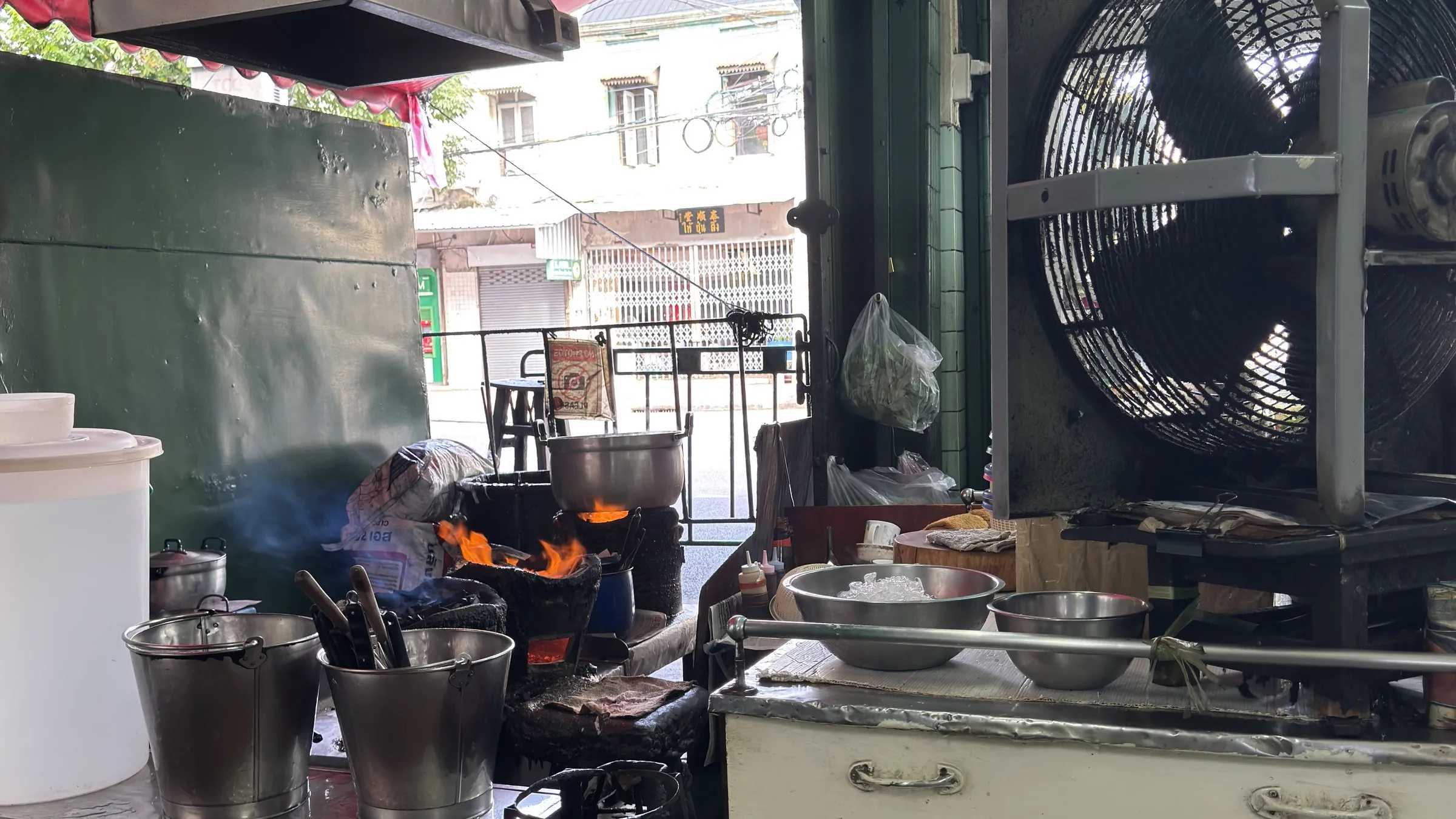
At 7:55 in the morning I am second in the queue. Jay Fai opens at nine, but inside the work has already begun. Three people are preparing the kitchen. A pot sits on the fire, embers glow under another stove, someone is arranging ingredients in a metal basin.
I came to eat at Jay Fai. Before I see the cook, I find myself watching the work it takes for her to begin cooking.
The station opens onto the street: a railing separates the stoves from the Bangkok traffic. Under a large metal hood, the braziers are blackened by years of fire. Steel buckets hold ladles and utensils with worn handles. A little further along there is a bowl of ingredients on ice, a stack of plastic baskets, cloths resting on the edges of the counters.
A large fan takes up part of the space. Nothing seems arranged to be looked at. Every object has a purpose, even when its place, to an outsider, looks random. I think of a Formula 1 pit garage, not so much for the speed as for the work that comes before the moment everyone turns to watch the driver.
Outside, the queue does not stand. A row of white plastic chairs runs along the pavement, and whoever is waiting sits down. On a white table, next to a sign asking people to line up, a laminated notice tells customers: “Jay Fai is the only chef in the house. She also prepares every dish one by one.” Getting a table and food, it adds, may take longer. By opening time, eight chairs will be taken, and two people will be waiting on their feet.
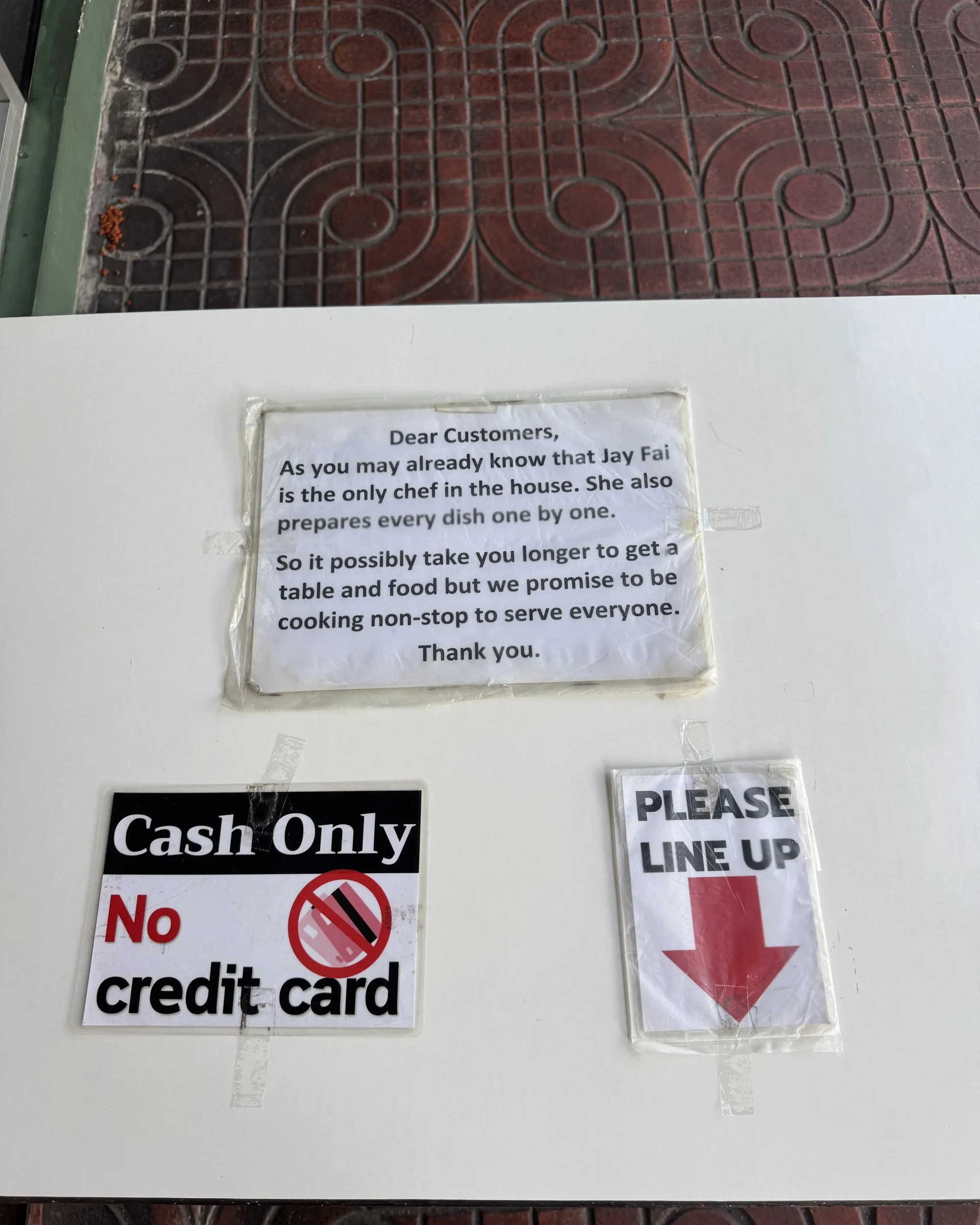
Photo: Alessandro Pavoni
A few minutes before nine, Jay Fai is at the station. She is wearing a wool beanie, the protective goggles that have become part of her image, a camouflage T-shirt and a black apron. She straightens the baskets and turns towards the fire.
Then she starts to cook: her hands, in blue gloves, move the utensils over the wok. Flames climb around the metal, while beside it a large pot keeps boiling. There is nothing particularly sophisticated about the tools: the heart of the work remains the direct relationship between the person, the heat and the ingredients.
Low technology, extreme specialisation.
As I watch her, the flames, the noise and the goggles draw the eye; the precision, though, lies elsewhere: in the continuity of her movements, in the ability to pass from one step to the next without having to decide, each time, how to do it.
I eat the crab omelette. It arrives rolled, a golden cylinder beside a few sprigs of coriander; cut open, it gives way to large white pieces of crab, more meat than egg. It is a simple dish, but its execution is not. Egg and crab lose their contrast and become a single flavour. From the first cut to the last mouthful I find the same precision.
But it would be a mistake to think of this as the kitchen of a woman who works alone. Around Jay Fai there is a team. The work of the others never stops, and it is not incidental: it is an integral part of what makes hers possible. The kitchen works collectively, but it is not built to be independent of the person who leads it.
A business organised this way inevitably meets a limit. Its output cannot grow simply by adding staff or another station. To get exactly the same result, you would also have to multiply the person it depends on.
We do not know how much of this balance was designed and how much grew, day after day, out of the needs of the work, and perhaps that is precisely what makes the kitchen interesting: it does not look like a system drawn up on paper, but like something that took shape through the work itself.
I think back to when I arrived, at 7:55. Inside, three people were already at work. The fire was lit, the ingredients were being prepared, the utensils were in their place.
Jay Fai was not yet at the wok.