The crumb
You begin with bread.
Before the peacock, before any dish carried in front of a prince, the pupil practises on the crumb of a large loaf, the soft inside, set on a dish and shaped like a cut of meat. A citron or a large turnip would serve as well, but bread has an advantage the master states plainly: “it can be found in every season.”
The table must be laid, and the pupil approaches it standing, facing it, “as if your lord were there.” The plate with the instruments goes on his right, the dish with the crumb on his left. On the plate are a salt cellar, the forks, the knives and a folded napkin, which he lays over his left shoulder. Some, the master notes, keep it on the arm or over the hilt of the sword; nowhere, in his judgement, is as convenient as the shoulder.
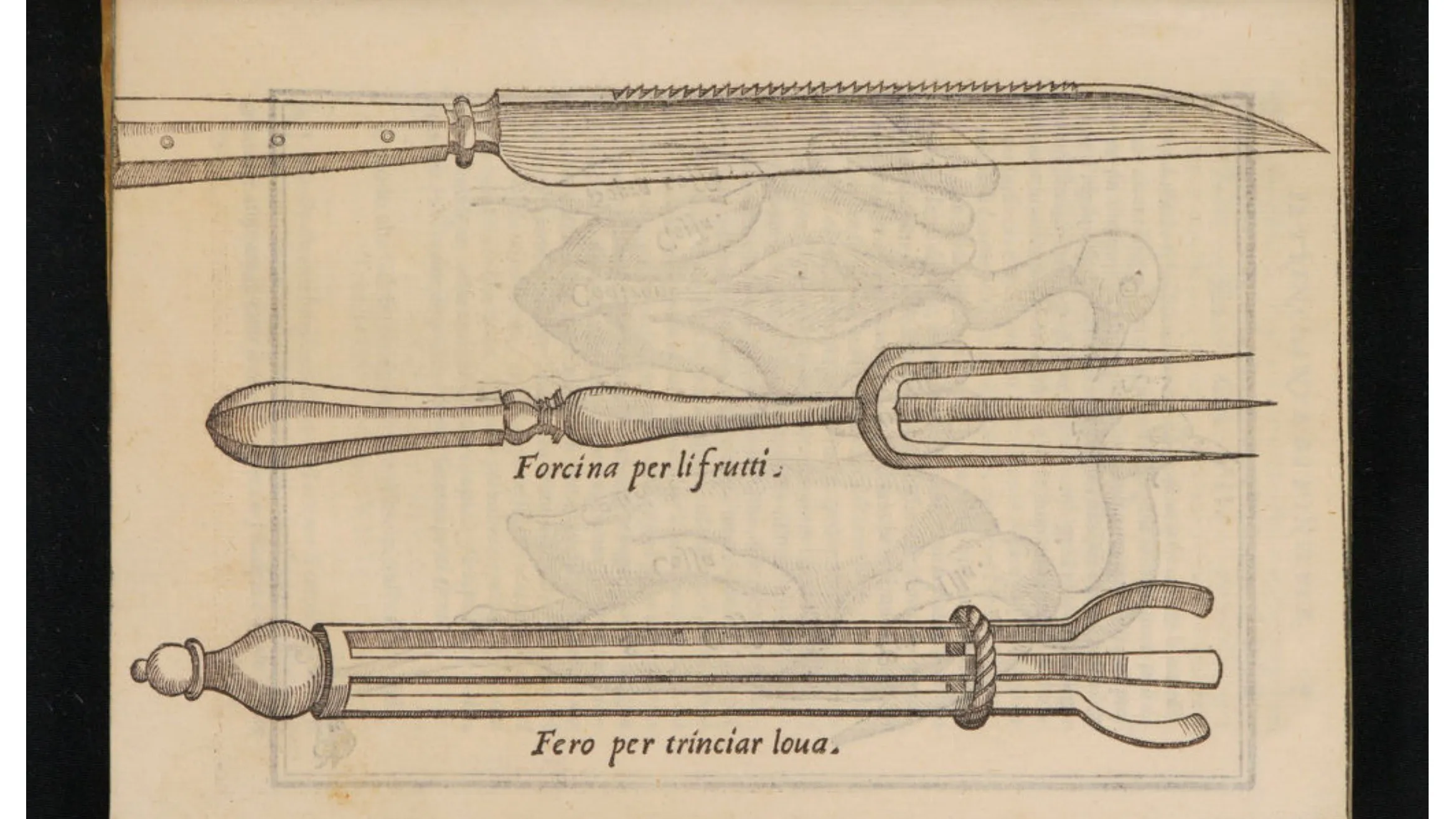
Then comes the body. Feet together, a palm’s breadth from the table. Back straight. In the left hand the forcina, an iron fork with two prongs; in the right, the knife. Both held with three fingers, because a fork gripped in the fist bears the weight but will not turn.
The crumb must be speared in the right place, so that it leans to neither side. Raised, the hands two palms above the table, it must stay still while the knife cuts broad, thin slices, which have to fall in the middle of the plate below. Salt goes on the rim of the plate with the point of the knife, never on the table. He changes plates without lowering the fork and without leaving his place, carves again, then returns what is left of the crumb to the dish it came from, wipes the instruments with the napkin and covers everything again. The exercise is repeated alone, many times, until the hand is ready to serve before the lord.
These are the instructions of the eighth chapter of Il Trinciante, The Carver, printed in Venice in 1581 by the heirs of Francesco Tramezzino. In his note to readers, dated 9 March, the publisher Venturino Tramezzino presents it as the completion of two books his shop had already printed, by Bartolomeo Scappi and by the cook known as Panunto. After the dishes to be cooked, what was missing was someone who could serve them, carving them before a great prince “with grace and polish.”
The book carries the name of Vincenzo Cervio, carver to Cardinal Alessandro Farnese, who died before seeing it in print. It was completed by Reale Fusoritto da Narni, who by then held his place at the cardinal’s table. How much of the text is Cervio’s and how much Fusoritto’s is not known for certain.
The treatise presents itself as a discourse by Cervio addressed “to a creato of his,” a pupil raised in his service, whom the book never names. The instructions are in the second person, as if the lesson were taking place in front of that laid table.
The pupil has not yet carved anything but bread. He has learned how to stand, how to hold two instruments and how to make the bread fall in the right place. This is the beginning of trinciare in aria: carving in the air.
The true carver
At the table of a great sixteenth-century lord, the man who carved the meat held a place close to the lord himself. The first chapter places the carver among the three offices of honour that princes assign “for the care of their mouth,” alongside the steward and the cupbearer. They are posts entrusted to people who are noble, trusted and of the household.
Then the master changes tone. In Rome, he writes, the office has fallen into disrepute through the meanness of certain prelates, who give a carver fifteen or twenty giuli a month, what a stable hand is paid. He has known capable, loyal carvers who served for many years and who, he says, “all day long were dying of hunger.” Other lords knew better: Cardinal Ippolito de’ Medici had given his Portuguese carver more than a thousand ducats of income.
The master then offers his own example. Cardinal Farnese took him into service at the start of his cardinalate, “without regard that I was born of a humble family,” and granted him a salary, then money, horses, clothes, a pension of sixty scudi and a chancery office worth eight hundred.
The next chapter complicates the picture. Whoever wants to be a carver, it says, ought to be born of an honourable family, or at least be very well brought up. And he must have “the means to spend”: clothes, servants and horses equal to the office, because a badly dressed carver is held of no account, however good he may be.
Between one chapter and the next, the sums do not add up. The man expected to appear with horses and servants is offered fifteen giuli a month. The book sets the two side by side and does not reconcile them.
In the same chapter the carver must be neither lame nor squint-eyed, neither too tall nor too short, because either “would be ugly to see carving.” He must speak little, know his master’s tastes, have good eyesight and judgement, and be loyal.
The third chapter is given to those who do not deserve the name. Barbers and the like, seen in Rome, Venice, Bologna, Florence and almost all of Lombardy, who tie a napkin under the belt like an apron and roll their sleeves back to the elbow, “as if they meant to set up a butcher’s stall.” They lay a capon on a large wooden board and cut it across with a large knife, without any consideration. The master calls them “butchers, or carvers for the servants’ hall.”
The difference lies in the gesture. The true carver, the fourth chapter explains, cuts everything on the fork held up above the dish: what, he adds, “is commonly called in Italy carving in the air.”
In France and Germany, the fifth chapter relates, princes’ carvers lift nothing. They plant the fork in the breast of the capon and cut their slices while it stays on the dish. To them that way seems very fine, the master concedes, and for some time, through familiarity with Italian courts, they have been adapting “to our way.” Later, faced with an old, tough peacock that will not be carved in the air, he advises cutting it on the dish “in the French or German manner.” So, he writes, should be done with every dish from which no honour can be had.
The Italian way calls for suitable instruments, and the treatise wants them in three sizes, large, middling and small. The fork is made of soft iron, so the edge of the knife does not chip against the prongs. The steel knife must be carefully tempered: too hard, and it chips or snaps against a bone; too soft, and in the heat of the meat it bends “as if it were wax.” One plate in the volume shows their shapes, another the joints of birds, the points where the knife must enter.
There remains the place. The carver stands facing the lord or at the head of the table, where he can be seen. Before the lord arrives he does not leave the food, not even to bring him water for his hands: that belongs to the cupbearer. When the lord sits, he takes off his cap, bows and puts it back on at once, because he needs both hands.
When the dishes arrive, he has them uncovered and tasted by whoever brought them. The treatise gives this tasting two reasons, ceremony and the suspicion of poison, and adds at once: “But unhappy the prince who lives continually in this fear.” For the tasting, a small cube of breadcrumb half a finger long is set out on the plate with the knives. At the end of the meal, the bread left over from the lord’s place belongs to the carver, “for a certain reputation it carries with it.”
A fine sight
After the crumb, the eighth chapter turns to how the man holding the knife appears. The pupil must not stand rigid “as if you had a stake driven in behind you,” nor wave his head and hands like those who seem to want “to play at sleight of hand and conjuring tricks,” which would set every onlooker laughing. The fixed posture holds only while the food is in the air. The rest of the time he may shift his feet, step up to the table, change a plate.
The prescriptions are concrete. The fork tilts slightly to the right, so the slices fall into the plate and not onto the hand. The knife is raised no higher than it needs to be. The body stays still. The more composed and graceful the carver, the master writes, the finer a sight he will make: in Italian, far bel vedere. The chapter closes with a formula: everything is to be done “without affectation and with good grace.”
Fifty-three years earlier, in 1528, Baldassare Castiglione had named affectation as the reef to steer clear of. In the first book of The Courtier he had set against it sprezzatura, “a certain sprezzatura that conceals art.” Soon after, he warned that sprezzatura too, once flaunted, turns into affectation: messer Roberto, who lets his robe slip from his shoulders and his slippers from his feet as he dances, to show he is not thinking about it, is thinking about it too much.
The Carver speaks the same language of the court, but puts it to its own use. In the eleventh chapter, if a peacock is too heavy to stay in the air until the last cut, the carver may set it down on the dish. He does so with ease, as though he meant to wipe his hands or move a plate, “so that it does not seem your hand is tired.”
The strain is hidden. The procedure is not. The book describes it stroke by stroke, joint by joint, and wants it seen: whoever holds a peacock up until he has carved it all makes a finer sight, and will be praised by everyone.
Castiglione’s courtier hides his art. The carver, when he must, hides the strain, but leaves the art in front of everyone present, because that is where it is judged. A dish wobbling on the fork, a slice landing outside the plate: these are seen at once.
The marvels
At the end of the introductory chapters, the master stops to say what he will not teach. He will not say how many strokes of the knife it takes to mince beef, nor how many bones and sinews there are in a pig’s foot, nor how many bones in a laccia, the shad, a fish that is full of them.
Nor will he perform “the marvels.” He recalls carvers who had boasted of feats made for show: taking every bone out of a laccia with fork and knife; spearing a suckling pig, lifting it and dismembering it entirely without ever taking it off the fork; spearing a melon and making the slices fall one by one, already freed from the rind, straight onto the plates. When it came to the test, he notes, they did not succeed.
From him, he adds, nothing of the kind is to be expected, “because I do not have it in me to know how to do it.” Coming straight after the others’ failure, the line leaves open how much of it is modesty.
The suckling pig, the laccia and the melon remain in the book as dishes to be served. The suckling pig is not speared: the flesh is too soft and would tear on the fork. Of the laccia, the hardest fish to carve well, the master recalls a man who promised to remove all its bones: he has watched him work many times, “and he did not perform so many miracles.” The melon is served one slice at a time.
Instead he returns to what can be passed on. All birds have the same joints, are speared through the back, and take more strokes or fewer according to their size and the parts to be made. He will begin with birds, and among birds with the peacock, because no creature is of greater price and esteem.
The peacock is large and hard to hold aloft. First its neck and both thighs come off: to lighten the hand, and because at the tables of princes they are not served anyway.
Then the master sets a limit. A peacock could be made into many parts. But if the carver means to give every piece its strokes at the right joints, however skilled he is, he cannot serve more than six people. There is a great difference, he writes, “between carving and merely gesturing”: some go through the motions with the knife and do not cut.
Of the peacock, then, six parts.
Sources
Translations of quotations from the Italian sources are our own.
Quotations are translated from Vincenzo Cervio, Il Trinciante, Venice, heirs of Francesco Tramezzino, 1581 (Wellcome Collection, Public Domain Mark), with the support of the AtLiTeG transcription edited by Veronica Ricotta (DOI 10.35948/ATLITEG/Corpus/94). Castiglione is quoted from Il libro del Cortegiano, 1528, Book I, chapters XXVI and XXVII.