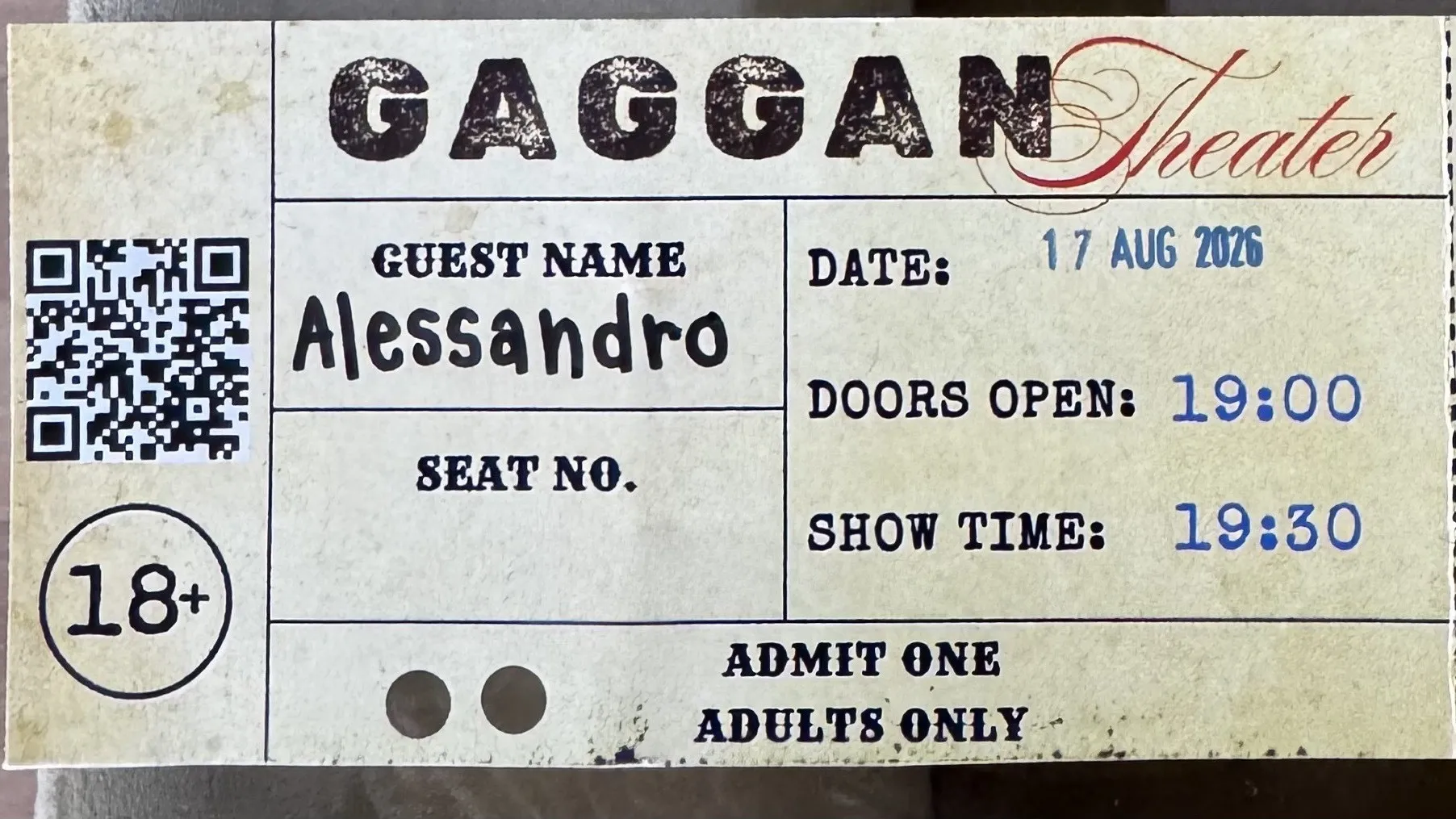
At 19:30 we were twelve strangers, sitting upright around a dark wooden table. A few hours later we were singing Bohemian Rhapsody.
The ticket I had been handed said Gaggan Theater. My name, Alessandro, written by hand; the date, 17 August 2026; and then two lines that belonged to a show rather than to dinner: Doors open: 19:00. Show time: 19:30. At the bottom, Admit one. Adults only. It did not say when dinner would be served. It said when the show would begin.
Inside, the room made the wording obvious. A large horseshoe table seated twelve. At its centre ran a steel counter at least two metres long; just behind it, a kitchen that was surprisingly small and almost entirely steel as well. Everything was exposed and close, with no real line between the place where the food was made and the place where we would eat it.
Twelve strangers put around the same table do what twelve strangers do: they watch each other. A few introductions, a few words, and that almost automatic composure you adopt on entering a serious restaurant while you work out its rules. We were earnest, attentive, perhaps a little shy.
On the other side stood Gaggan’s team: more than ten people, young, from different parts of the world. The first impression was of a group that was orderly, focused, ready. There was the contained tension that precedes something long prepared: everyone in place, alert to what was happening around them, waiting for it all to begin. As the evening went on, a great deal more would surface.
One course at a time, one of them would take the stage. For a few minutes that dish was theirs, and in the presentation, the gesture or the construction you could sense something that belonged to that person: an idea, a contribution, a piece of the work that had led to what we were about to eat. Then they stepped back and someone else took their place.
Gaggan remained recognisable behind each of them, in the shared vision and above all in the freedom with which each managed to bring something of their own. They did not look like people assigned to repeat a fixed performance every night. They looked like people still interested in finding out what might happen.
A score
Dinner began to follow a logic that was not yet apparent. A dish, a piece of music, a gesture; then another dish and another person taking the stage. The rhythm kept shifting, and so did the volume and the way we were asked to take part.
The music was not a soundtrack laid over dinner. Each dish seemed to have its own, chosen to accompany its arrival, its presentation or the gesture with which we were asked to eat it. Languages and genres changed, but the sense was of a score written alongside the menu: restrained at first, then progressively more present, more physical. Music, cooking and movement followed the same trajectory, pushing back a little at a time the limit of what we would have expected to do sitting at that table.
At first we watched them work, listened to the explanations, tried to understand what was in front of us. Then we began to touch, to eat with our hands, to laugh more easily, to talk to the person beside us. No one announced that the rules had changed. The rules were changing.
Gaggan never asks you to lose control. He takes it from you a little at a time.
Fine dining has trained us in a fairly precise grammar. We walk in knowing more or less how to behave: the posture, the distance, the service, the dish that arrives, the explanation that comes with it, the tasting and finally the verdict. Even when the cooking is radical, the behaviour of those receiving it is often surprisingly conventional.
Here that grammar was steadily eroded, not to be replaced by confusion but by another grammar, built for that room and those few hours. The further the evening went, the less we were asked to observe and the more we were called on to take part. The table slowly stopped being the boundary between those making and those receiving.
At one point a globe appeared in front of us, drawn directly on the plate. Around and over it, small sweet elements completed the picture without allowing any single flavour to dominate. There was no sugar imposing itself, no precise taste to recognise and name. The sweetness stayed almost in the background, as if the dessert had been built to leave room for what actually mattered. The dish was called Lick It Up. To eat it, you had to lick it.
I licked the world.
And the point, at that hour of the evening, was no longer only what I was eating. It was that I was doing it. A few hours earlier we had walked in composed, intent on working out the rules of that table. Now nobody seemed especially interested in putting up resistance.
Every dish, after all, began with a story. Not a description of ingredients or technique, but something that immediately widened the field: a problem, an intuition, an ingredient normally overlooked, a different way of using what was available. Sometimes it was sustainability; sometimes the energy it takes to produce and transform food, the reduction of waste, the recovery of humble ingredients or of parts normally discarded, reuse, circularity.
Whoever took the stage did not only explain how a dish had been made. They explained why. The kitchen seemed to move in one clear direction: not starting from an ingredient and building a story around it, but starting from an idea and looking for the form it could take on a plate.
Behind the scene
None of this would have held for more than a few minutes without a kitchen capable of carrying it. The dishes kept arriving as the room grew steadily less composed. The ideas we had been told found concrete form: using every possible part of an animal, recovering what would normally be thrown away, giving a humble ingredient centre stage, transforming rather than discarding. It happened with pork, with snake, and with ingredients whose meaning changed through the way they were used. There was no lesson on sustainability before the dish. There was the dish.
Meanwhile, in the cramped space behind the counter, more than ten people kept taking turns without the evening ever losing its direction. The discipline it takes to run a kitchen at that level lived alongside something less predictable: they laughed, intervened, joined in with what the others were doing. What I had first seen as an orderly, focused group turned out above all to be an involved one.
Twelve strangers
On our side of the counter, meanwhile, something had happened too. The facts that had served to introduce us had steadily lost their weight. Italy, France, Austria, Korea, China, Japan. That is where we had come from, but by then we were simply twelve people going through the same thing.
The music had grown louder, we were talking more, the team kept stepping into the relationship with the table. The steel surface I had read at the start as the edge of the stage no longer separated with the same clarity those putting on the show from those watching it.
Then the room went completely dark. The table was gone, the kitchen was gone, so were the people who a moment earlier had been standing in front of us. In the dark, Michael Jackson’s Thriller came on.
The music filled the room, and the composure we had walked in with a few hours earlier no longer had any reason to exist. The team and the twelve around the table were by now part of the same thing. Then came Bohemian Rhapsody.
And we sang. All of us.
The same people who a few hours earlier had introduced themselves politely around that table were singing along with the crew who had cooked for them all evening. I cannot remember the precise moment the initial composure disappeared. No one had ordered us to enjoy ourselves; no one had announced that from now on we were allowed to be less serious. The distance between the entrance and that moment had been covered a centimetre at a time, dish after dish, story after story, song after song.
Analogue
Before anything began, the cameras on our phones were covered. The phone could stay with us, but for a few hours it would not be able to see.
In an evening built with such visual care, the gesture took on a precise meaning. We were being deprived of something we now do almost without thinking: turning what we are experiencing into an image, instantly. A dish could not become a photograph before it had been tasted; a gesture could not become a video while it was still happening. What was going on in front of us could not be watched through a screen at the same time, stored, and shown somewhere else. We had to be there.
On his website, Gaggan calls it “the analogue of theatrical cooking”. That evening, the word analogue felt far less decorative than it might read outside that room. For a few hours we had given up the possibility of building, as it happened, the digital archive of what we were living. The archive would come afterwards.
Greatest Hits Vol. 1
At the end we were handed a small aluminium tin made to look like an old cassette. On the front it said Greatest Hits Vol. 1.
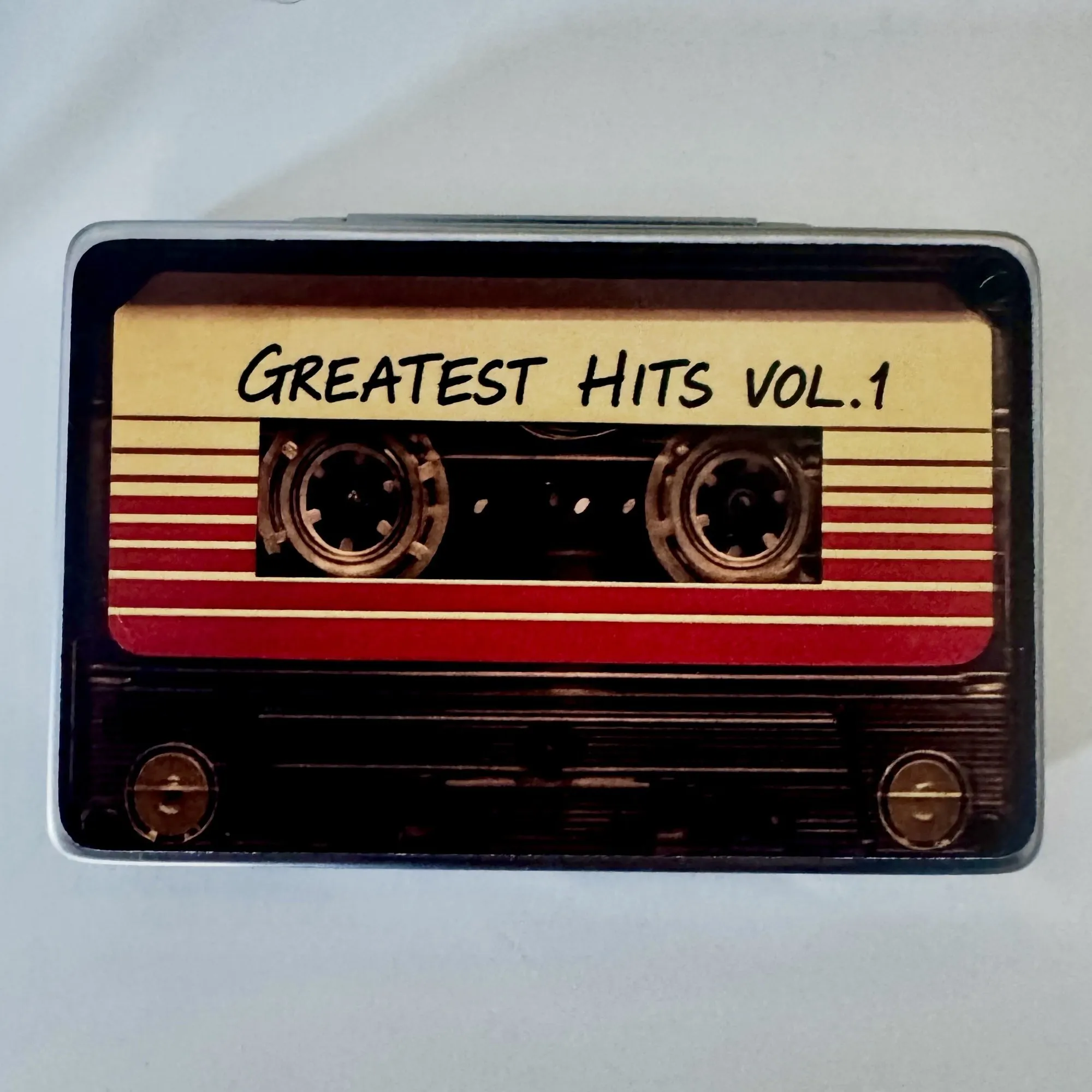
Photo: Alessandro Pavoni
Inside were twenty-eight illustrated cards, one for each part of the dinner: Som Tam Mandala, Dry Martini, Charcoal No. 222, Butter Coffee, Crab Curry, Black Forest, Honeycomb, Dying Eggplant, Salmon Raita, Pepper Fry, Liquid Tension Experiment, Nut Case, Sesame Cube, Egg & Milk, and many more. And, among them, the one I now knew well: Lick It Up.
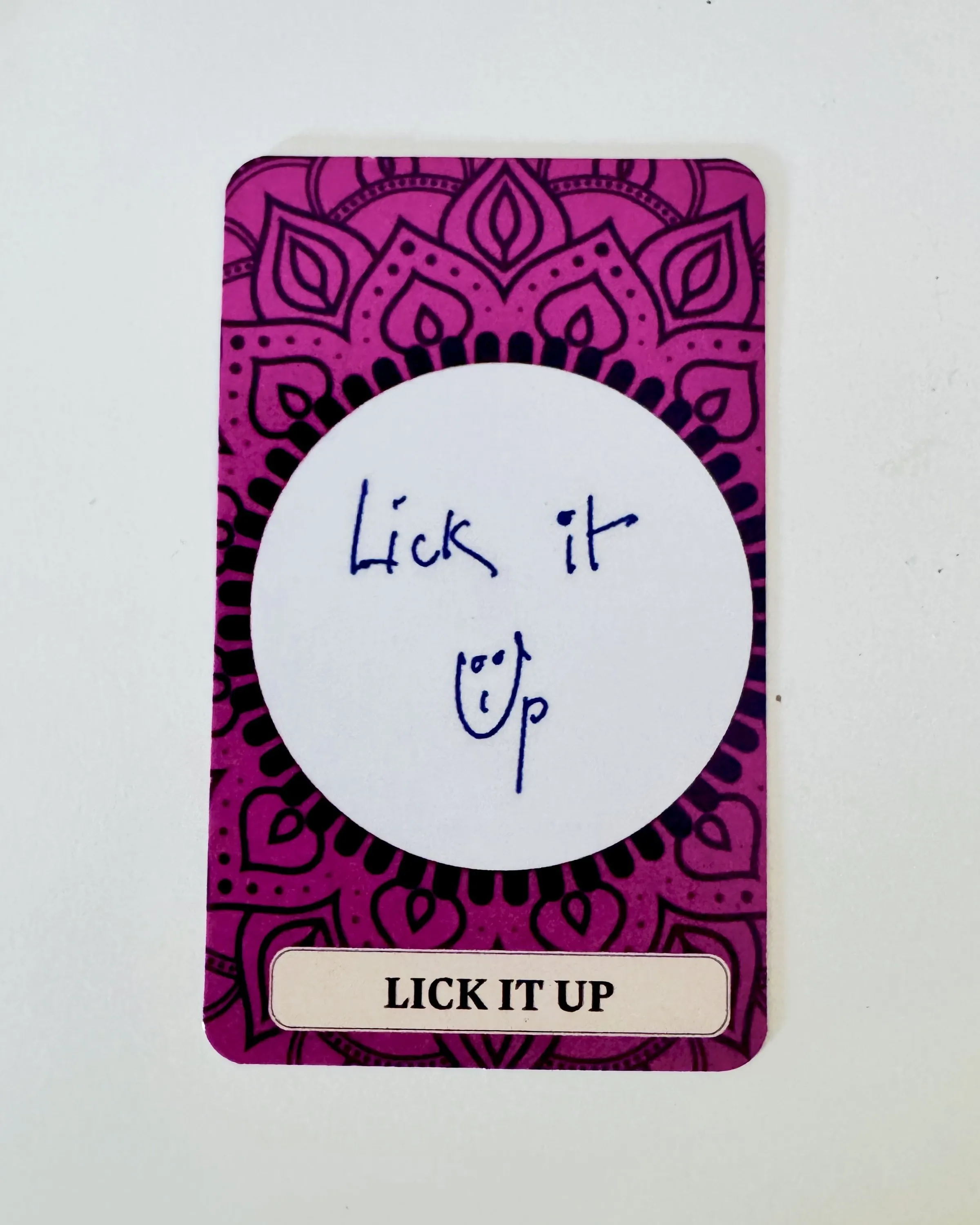
Photo: Alessandro Pavoni
It was the evening’s menu, but it no longer looked like one. It looked like the tracklist of something we had just attended. Or taken part in.
Inside the open tin, on its base, four fields held four words: Juvenile, Prominence, Defiance, Nirvana. Under each, six more.
Young, innocent, growing, immature, childish, adolescent.
Self-esteem, name, eminence, fame, expectation, prestige.
Confidence, persistence, rebellion, tenacity, stubbornness, challenge.
Rebirth, awakening, happiness, peace, spirituality, liberation.
They can be read as a personal trajectory, Gaggan’s own: growth, recognition, rebellion, a fresh start. But after those hours around the table it was hard not to recognise in them something of what had just happened to us.
I thought back to the ticket I had been given a few hours earlier. Everything that had happened seemed constructed with extreme precision to produce the one thing that could not be predicted: the reaction of twelve strangers.
Show time: 19:30.
I had assumed the show was what would take place in front of us: the kitchen, the dishes, the music, that group of young people taking turns on the stage. Only at the end did I understand that Show time did not only mark the hour when what was in front of us would begin.
At some point, without noticing, we had entered the show too.