There are evenings that do not need to be explained right away.
Or rather: perhaps their value begins precisely when we stop wanting to define them. When the wine is no longer a tasting sheet, the dish no longer a performance, the table no longer an event to be recounted, but a place where something happens.
This dinner in the Val d’Orcia was, before anything else, a pause — a sosta. Not in the light sense of a break, but in the deeper sense of stopping: stopping before a gesture, a sequence of flavours, a glass that changes while you listen to it, people who do not yet know one another and who, little by little, find a common rhythm.
The most interesting thing, perhaps, was exactly that: the rhythm.
At the start a table is always a small, provisional geography. You take each other’s measure, you observe, you work out where to sit even once you are already seated. Then, if the hospitality truly works, something loosens. Not because everything turns instantly familiar, but because the evening finds its own temperature. That night it happened naturally, almost silently: the wine opened a conversation, a dish shifted its tone, a story added depth, a pause let everything settle back.
There was nothing to prove. There were a table, a kitchen, some wines, some people. There was the care of those who had built the path and the openness of those who walked it without wanting to possess it at once. There was that form of convivial intelligence that is born not from competence on display, but from the capacity to listen: to the dish, to the wine, to the story, to the silence between one course and the next.
Before the dinner had really begun, Giacomo told the story of the project. Not in the way — by now fairly predictable — in which gastronomic experiences are often introduced: a few words on the idea, a reference to the territory, an elegant frame to hold it all. Here the telling had another weight. You could sense that behind the evening there was not merely the wish to stage a successful event, but the will to give form to a vision.
An enlightened project, in the most concrete sense of the word: able to cast light on things without overexposing them.
The Val d’Orcia was not a backdrop. Tuscany was not a quotation. The Cinta Senese was not an identitarian detail used to make the menu more recognisable. Everything seemed called to take part in a wider discourse, where the place was not declared, but allowed to emerge. This makes an enormous difference. Because territory, when it is told too much, risks becoming a postcard. When it is handled with intelligence, it returns to being living matter: flavour, memory, the gesture of farming, animal, landscape, culture.
Then the project found its voice in Andrea’s telling.
His account did not simply accompany the wines. It placed them. It set them in relation to the kitchen, to time, to the reason behind each choice. It was not a sequence of information, but a form of guidance. Passionate, precise, never cold. The kind that does not try to demonstrate competence, because the competence is already in the way it holds things together.
Each bottle seemed to arrive not to occupy the centre of the stage, but to open a passage. Every pairing had a reason, and that reason was never merely technical. It was narrative. It was sensory. It was, above all, coherent.
That is where the tasting definitively stopped being a tasting and became an experience. Because a tasting can be extraordinary, yet it often stays vertical: the wine, the dish, the pairing, the judgement. Here, instead, everything worked in a more circular way. The wine explained the food, the food altered the wine, the story prepared the taste, the taste called the story back into question.
The kitchen worked in exactly this direction. It did not chase the special effect, or at least not the most obvious one. It built a sequence in which surprise arrived not as a theatrical gesture, but as a gradual shift in perception. Some dishes did not want to win you over at first bite. They asked you to follow them, to understand where they were going, to accept that elegance does not always coincide with softness, and that depth, at times, also passes through a certain subtraction.
In the middle of it was this very particular thing: an omakase kitchen able to meet the Tuscan world without disguising it and without betraying it.
The most interesting part was not the encounter between Japan and Tuscany as such. It would be easy to put it that way, but it would also be too simple. The real point was the manner in which that encounter happened. Omakase carries with it a precise idea of trust. You entrust yourself. You accept a sequence. You enter a rhythm decided by someone else, but you do so not out of passivity, rather out of willingness. It is a ritual of attention before it is a form of cooking.
To set within that ritual a matter so profoundly Tuscan, so physical, so bound to the earth as the Cinta Senese, could have become an exercise in style. Instead it worked because it did not seek the spectacular contrast. It sought a subtler continuity.
On one side the precision, the cut, the sequence, the almost silent gesture of Japanese cooking. On the other the animal, agricultural, material depth of Tuscany. Two seemingly distant worlds, yet able to speak to each other if neither is used as the decoration of the other. Perhaps it was right there that the evening found its identity.
Not in fusion, a word that often simplifies too much. Not in contamination, which at times seems to want to justify everything. But in a form of mutual listening. The Japanese kitchen did not domesticate Tuscany. Tuscany did not weigh down the Japanese gesture. They met in a common measure.
This, for me, is one of the highest points of a successful dinner: when you do not have the sense that someone is trying to impress you, but that everything has been thought through to take you to a more precise place. Not higher. More precise.
Because true hospitality is not the accumulation of beauty, service, raw material, bottles, gestures and words. It is finding a measure among all these elements. It is making them coexist without one having to devour the other. It is letting food be food, wine be wine, conversation be conversation — and yet allowing them, together, to become something more.
The wine, in this sense, was not the absolute protagonist. It was, rather, a lens.
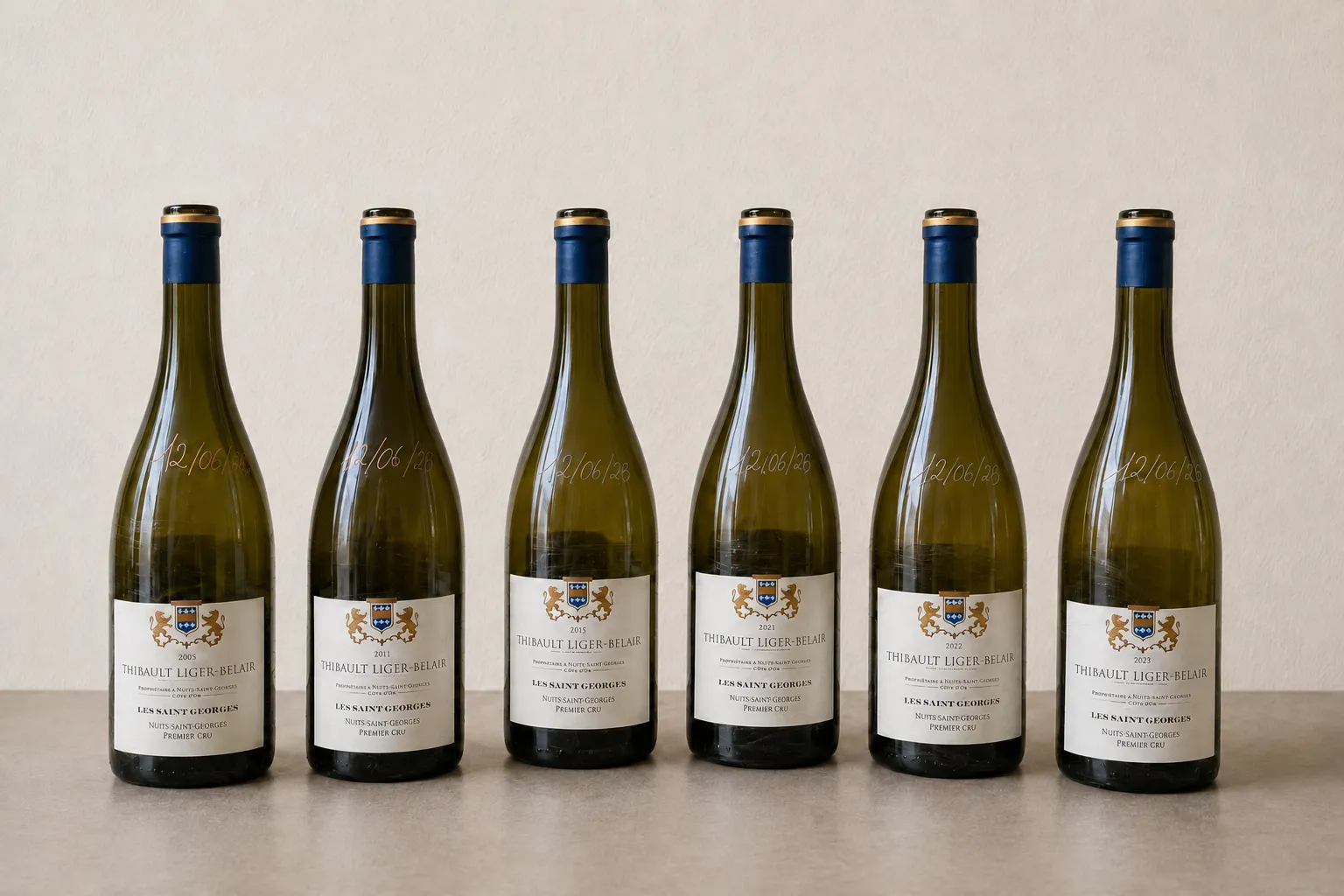
On the table was a vertical of Thibault Liger-Belair, Nuits-Saint-Georges 1er Cru Les Saint-Georges: 2005, 2011, 2015, 2021, 2022 and 2023. An important sequence, not only for the worth of the bottles, but because it let you cross the same place in different times. The same parcel, the same idea of wine, but vintages able to return different characters, tensions and degrees of maturity.
In technical terms, the 2005 was probably the most accomplished wine, the most assured, perhaps even the most memorable. It had that confidence of great wines that do not need to explain themselves too much: depth, balance, authority, a full and natural presence. And yet, for me, something happened on the 2015.
Not because it was “better”. That would be the wrong word, and perhaps a useless one too. But because within a vertical like this no vintage ever lives alone. You drink it before and after something else. You listen to it by contrast, by continuity, by distance. And sometimes it is not the most resolved wine that leaves the strongest trace on you.
Some bottles opened conversations, others shifted the mood of the table, others still created a small friction between expectation and perception. And perhaps that is where the experience became most interesting: not when everything confirmed what we already knew, but when something obliged us to stay present.
The 2015 was, for me, one of those moments.
I would not tell it as an immediate revelation. That would be too simple, and perhaps not quite true. It was, rather, a wine that asked for attention. A serious wine, deep, with dark fruit, a structure still evident, a mineral and earthy part that kept it from becoming simply seductive.
But the point was not to establish whether it was “worthy” of its fame. The point, at least for me, was another: to understand what happens when the authority of a bottle meets the real perception of the one drinking it. There is always a moment, before a great wine, when you have to decide whether to keep listening to what you know, or to begin listening to what you feel.
That evening, on the 2015, this passage became clear. Not as dissent, not as judgement, not as the will to take a position. Rather as a small exercise in freedom. The freedom to stay faithful to experience, even when it does not perfectly coincide with expectation. The freedom not to have to turn every taste into confirmation. The freedom, far rarer, to inhabit doubt without ruining it.
Because taste, when it is truly lived, is never merely approval.
It is memory, comparison, doubt, surprise, resistance. It is the point where what we have read, learned or imagined finally meets what we feel. And sometimes the two do not coincide. But it is precisely in that gap that the most fertile space opens.
This was perhaps the finest part of the evening: not the perfection, not the rarity, not the impeccable sequence of things, but the possibility of staying inside an experience without having to close it at once into a formula. Letting the wine go on changing in the glass, letting the dishes find their sense in the memory of the sequence, letting the people seated around the table become, gradually, part of the experience itself.
Because a dinner, when it truly works, is never merely the sum of what is served. It is the way things hold together. The way a story prepares a taste. The way a wine reopens a conversation. The way a course arrives at the right moment — not only for gastronomic balance, but for the emotional temperature of the table.
It is a fragile construction, and precious for exactly that reason. It takes little to break it: too much explanation, too much performance, too much will to make memorable what should first be lived. That evening, instead, memory was not pursued. It came afterward, as a consequence.
The value was not in the rarity of the bottles, nor in the sequence of the dishes, nor in the evident beauty of the setting. Or better: it was there too. But not only there. It was, above all, in the way all of this found a measure. A measure made of attention, story, matter, time. Of people seated at the same table not to consume an experience, but to let themselves be changed, even only slightly, by what they were living.
Perhaps this is what remains.
Not the precise name of each wine. Not the perfect description of each course. Not the need to turn the evening into a verdict.
What remains is a form of presence. The sense that, for a few hours, time had stopped being merely something to be filled and had become an inhabitable space. A place where taste, hospitality and conversation found a single frequency.
And perhaps certain experiences are worth telling precisely for this: not to be archived, awarded or explained, but so as not to let them pass too quickly.